Sunday, September 5, 2010

How Many Groups of 10?

There are 132 flyers that need to be handed out to Extended Day classes. The flyers need to be organized in stacks of ten to make them easier to hand out. How many stacks of ten will there be? How many flyers will be left over?

When looking at a two digit number, it is easy for students to determine how many tens and ones are in the number. When working with a three-digit number, students have to understand a little more about place value. In working with 100, students first need to understand how many tens are in each group of 100 in order to solve. This can be a little abstract for students at first.

To help them understand how many groups of 10 are in 100, we bring out the place value blocks for a visual. Let's start by representing the number 132 with place value blocks.

It is important for students to understand how many groups of 10 are in 100. By using the place value blocks, students can count the groups of ten easily.

When students understand that 1 group of 100 is equal to 10 groups of 10, they are able to solve these problems easily. Student work may look something like the following:

In the strategy above, the student drew a representation of the place value block model to explain her thinking.

In the strategy above, the student used a modified open number line to keep track of the number of groups of tens and singles.

In the final sample above, the student wrote what she knew about the number of groups of ten in 132. These are just several student samples. There are many more ways students can solve and model their thinking for problems like these.

Wednesday, May 19, 2010

Closing Meeting Strategies

Check out this great thinking from a second grade closing meeting!

Oops! The factory put 101 paper clips in each box instead of 100! How many paper clips will you get if you buy 9 of these boxes?

Closing Meeting Paper Clips from Melissa Ross on Vimeo.

Thursday, April 22, 2010

Harder Balancing

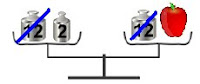
As we are mastering the balance/scale problems, we have moved into problems that require a little more thought and strategy rather than guess and check methods.

In the problem above, students begin to see that if they remove the same amount of weight from each side of the scale, it remains balanced.

By removing 12 grams from each side, the student would conclude that the apple weighs 2 grams.

Finally, in second grade, we move to multi-step balance problems. This problem is an example of one of the more challenging problems your child will encounter this year.

First, students begin by eliminating the same amount of weight from each side. They know they need to keep the scale balanced in order to help them solve the problem.

Finally, students use the weight that is left to divide evenly to each flower. At this point, some students may try break the number apart into groups, or begin with a simple skip counting "guess and check" method. In this problem, the solution is simple. There are 5 flowers left, so each flower must be worth 5 grams.

Thursday, April 8, 2010

Balancing Apples

As part of the Florida Algebra standards for second grade, students are required to “describe and apply equality to solve problems, such as in balancing situations” to a high level of cognitive complexity. In other words, students must be able to look at a situation and determine the unknown by using what they know about the problem. What great critical thinking for our second graders! (They think of these problems as puzzles and love them!)

Let’s take a look at a basic example:

Alyssa made two identical apples balance with two different two gram weights. How much does each apple weigh?

Most students can easily see that there are two identical apples and two identical amounts of weight. Each apple must be worth two grams. 1apple = 2g or 2g = 1 apple. These problems are not all this simple. Here is another example:

This time, Alyssa made five identical apples balance with fifteen grams. How much does each apple weigh?

Students usually begin by skip counting by a number smaller than the overall weight (fifteen grams). They know that each apple weighs exactly the same amount, and solve these problems by repeated addition using a “guess and check” method. In the beginning, they may try each apple weighing 1 gram.

At this point, students usually quickly notice that the apples do not weigh enough to balance the scale. Students would then use a larger number to try to balance the scale. (As students become more familiar with multiplication and division concepts, they begin to look at these problems differently. In second grade, we are building their thinking and number sense to this point.) Students would finally solve the problem as: 1 apple = 3 g or 3 g = 1 apple.

Of course these problems get much more complex as time goes on. Look for more of these exciting balance problems coming home soon! In the mean time, check out some of the links below:

(Easy, Medium, and Difficult) Math Mammoth
(Easy, Medium, and Difficult) Illuminations and Student Sheet
(Difficult) Math Playground

Tuesday, September 1, 2009

Sunshine State Standards

Are you new to the Sunshine State Standards? Check out the standards for each subject area by visiting the Florida Department of Education.

Saturday, August 29, 2009

Math : Critical Thinking : : Analogies : Fun

Math analogies in second grade? Absolutely! We have added a daily math analogy to our Calendar Math routine in the mornings to develop deeper critical thinking skills among our students and to expand their math vocabulary. An analogy is simply a way of looking at items and determining the type of comparison that is being made among them. At the beginning of the year, we start out very simple. Here is the first one we did in class:

one : 1 : : three : _____

When read aloud, a student would say, “One is to 1 as three is to blank.” Students would then look at the first part of the analogy.

How are one and 1 related? One is the word form of the number 1.

After students determine the relationship of the first part of the analogy, they use that information to help them determine what the answer to the analogy is.

Three is the word form of the number 3, which means one : 1 : : three : 3.

As the year progresses, our math analogies will get more difficult. Relationships between the two parts will not always be synonyms. Sometimes the relationships will be antonyms or parts of a whole. Students will have to determine the type of relationship first before being able to solve the analogy.

Here are several more samples for the beginning of the year:

Greater than : > : : Less than : _____

15, 25, 35 : 45 : : 11, 21, 31 : _____

1, 3, 5 : odd : : 2, 4, 6 : _____

Want to do a little more practicing at home? The Critical Thinking Co. has a few great resource books to check out.